
Let’s be honest — keeping a clean home sounds simple until real life gets in the way. Between work, kids, errands, and everything else on your plate, your house cleaning routine is often the first thing to fall apart. One missed weekend turns into two, and suddenly you’re staring at a kitchen that feels like it belongs on a before-and-after TV show.
But here’s the thing: a realistic house cleaning routine doesn’t have to be complicated or time-consuming. The right system, broken into daily, weekly, and monthly tasks, can cut your cleaning time in half and keep your home consistently tidy without the Sunday panic-clean.
In this guide, you’ll discover seven game-changing tricks to build a house cleaning routine that actually works — whether you’re a working mom, a busy professional, a beginner, or simply someone who wants a cleaner home without losing their entire weekend to chores.
What Is a House Cleaning Routine (and Why Do You Need One)?
A house cleaning routine is a structured schedule that organizes your household chores by frequency — daily habits, weekly tasks, and monthly deep-clean sessions. Instead of cleaning reactively (when things get gross), a solid routine keeps your home at a steady baseline of clean.
Studies from organizations like the American Cleaning Institute consistently show that people with structured cleaning habits spend significantly less total time cleaning compared to those who do infrequent marathon sessions. A well-organized house cleaning routine also reduces stress, improves indoor air quality, and makes your home a more inviting place to live.
Whether you need a printable house cleaning routine checklist, a weekly cleaning schedule for your family, or a simple home cleaning schedule you can actually stick to — this guide covers it all.
Trick #1: Build Your House Cleaning Routine Around Daily Habits First

The secret weapon of every spotless home? Consistent daily cleaning habits that take less than 20 minutes total.
Think of your daily house cleaning routine as your baseline — the small actions that prevent messes from piling up into overwhelming cleaning sessions. Here’s what a realistic daily cleaning schedule looks like:
Every morning (10 minutes):
- Make the beds immediately after getting up
- Wipe down bathroom counters and mirrors while getting ready
- Start a load of laundry if needed
Throughout the day:
- Clean up after every meal — dishes in the dishwasher, counters wiped
- Do a quick tidy sweep before leaving a room
Every evening (10 minutes):
- Run or empty the dishwasher
- Wipe kitchen counters and stovetop
- Do a 5-minute whole-house tidy (put things back where they belong)
- Sweep or quickly vacuum high-traffic areas
These daily cleaning habits for a clean home are the foundation. Once they become automatic — and they will — your house cleaning routine becomes much easier to maintain.
Trick #2: Use the Room-by-Room Method for Your Weekly Cleaning Schedule
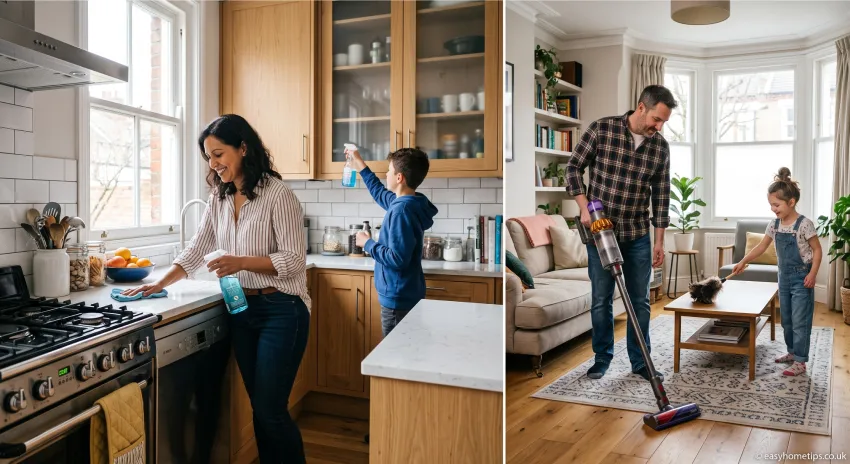
Trying to clean the entire house in one day is exhausting and unsustainable. Instead, the best house cleaning routine for beginners (and busy people) spreads tasks across the week using a room-by-room approach.
Here’s a sample weekly cleaning schedule for families that distributes the workload:
Monday — Kitchen Deep Clean
- Scrub the sink and faucet
- Wipe appliance exteriors and handles
- Clean inside the microwave
- Mop the kitchen floor
Tuesday — Bathrooms
- Scrub toilets, sinks, and tubs
- Clean mirrors and light fixtures
- Replace towels and bath mats
- Sanitize high-touch surfaces
Wednesday — Living Areas
- Dust all surfaces and shelves
- Vacuum upholstered furniture
- Wipe electronics and remotes
- Clean windows and glass doors
Thursday — Bedrooms
- Change bed linens
- Vacuum and/or mop floors
- Dust ceiling fans and blinds
- Declutter nightstands and dressers
Friday — Floors & Laundry
- Vacuum all carpets
- Mop hard floors throughout the home
- Finish and fold laundry
Weekend — Flex Day
- Catch up on anything missed
- Handle one monthly task (see below)
This room-by-room house cleaning checklist means you’re never doing everything at once, and each room gets proper attention every single week.
Trick #3: Create a Monthly House Cleaning Routine for Deep-Clean Tasks
Your daily and weekly house cleaning routine handles the surface-level stuff beautifully. But certain tasks only need attention once a month (or even once a season). Scheduling them prevents neglect without letting them pile up into overwhelming deep-clean days.
Monthly house maintenance checklist:
- Clean inside the refrigerator and freezer
- Wipe down cabinet fronts and drawer pulls
- Descale the coffee maker and kettle
- Clean the oven and range hood filter
- Vacuum refrigerator coils and behind large appliances
- Wash shower curtains and liners
- Scrub grout lines in bathrooms and kitchen
- Clean light switches, door handles, and baseboards
- Wipe walls around high-traffic areas
- Test smoke and carbon monoxide detectors
This monthly house maintenance checklist keeps your home functioning at its best and prevents small maintenance issues from becoming expensive problems.
Trick #4: The “Two-Minute Rule” That Transforms Your Cleaning Routine
One of the most powerful — and simple — tricks in any house cleaning routine is the two-minute rule: if a task takes two minutes or less, do it right now.
Saw a water ring on the coffee table? Wipe it immediately. Noticed the bathroom mirror is speckled? Clean it while you’re brushing your teeth. This habit alone can prevent 80% of the clutter and grime that builds up between your regular cleaning sessions.
The two-minute rule is especially effective as part of a realistic house cleaning routine for working moms and busy people because it eliminates the “I’ll do it later” trap. Most small messes, handled instantly, take far less time and effort than the same mess left for days.
Trick #5: Use Zones to Divide Cleaning Responsibility in Family Households
If you’re managing a household with kids or a partner, your weekly cleaning schedule for families becomes far more effective when you assign cleaning zones or responsibilities.
Zone-based house cleaning routine example:
- Zone A (Kitchen & Dining): One adult or older teen handles weekly kitchen deep-clean and daily after-dinner cleanup
- Zone B (Bathrooms): Rotated weekly between household members
- Zone C (Common Areas): Shared — everyone tidies the living room, hallways, and entryways before bed
- Zone D (Bedrooms): Each person is responsible for their own space
Children as young as 5 or 6 can handle age-appropriate tasks like putting toys away, wiping low surfaces, or sorting laundry. Building chores into your house cleaning routine as a family teaches responsibility and reduces the burden on one person.
Trick #6: Build a Printable House Cleaning Routine Checklist You’ll Actually Use
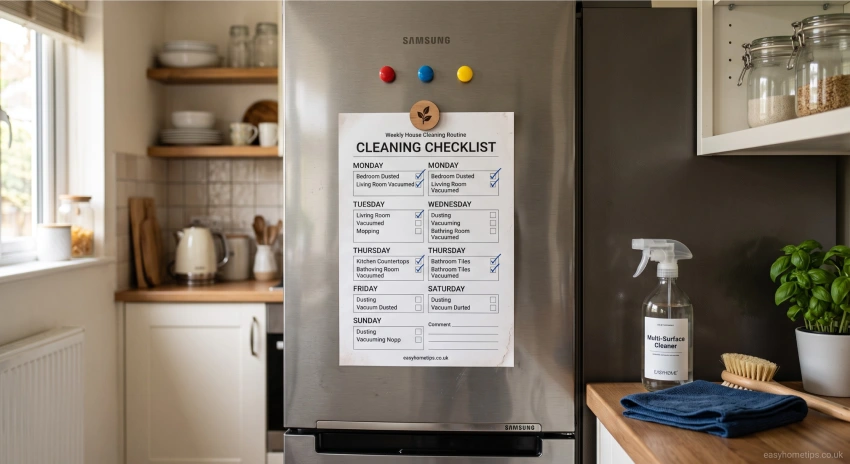
The most effective house cleaning routine is one you can see, check off, and refer back to. A printable house cleaning routine checklist works better than mental lists because it removes decision fatigue — you don’t have to think about what to clean, you just follow the list.
Your complete house cleaning routine checklist should include:
Daily Section:
- Make beds
- Wipe kitchen counters after every meal
- Load/run/empty dishwasher
- 5-minute whole-house tidy
- Wipe bathroom sinks
- Sweep high-traffic floors
Weekly Section (by room):
- Kitchen deep clean
- Bathrooms scrubbed
- Living areas dusted and vacuumed
- Bedrooms: linens changed, floors cleaned
- All floors swept and mopped
- Laundry washed, dried, folded, and put away
Monthly Section:
- Refrigerator interior cleaned
- Oven cleaned
- Cabinet fronts wiped
- Baseboards and light switches cleaned
- Appliances cleaned behind and under
- Shower curtains laundered
Seasonal Section:
- Windows washed (inside and out)
- Ceiling fans dusted
- HVAC filters replaced
- Garage/basement decluttered
- Outdoor areas cleaned
Pin this checklist inside a kitchen cabinet or photograph it for your phone. The visual reminder makes your house cleaning routine far easier to follow consistently.
Trick #7: Adapt Your House Cleaning Routine to Your Real Life
Here’s the truth most cleaning guides won’t tell you: the perfect house cleaning routine is the one that actually fits your lifestyle — not the aspirational schedule that looks beautiful on Pinterest but collapses by Wednesday.
A realistic house cleaning routine for working moms might look entirely different from the routine of someone who works from home or someone without children. And that’s completely fine.
For working moms and busy professionals:
- Front-load cleaning tasks earlier in the week when energy is highest
- Use the weekend for just one or two larger tasks, not an all-day marathon
- Keep cleaning supplies in each room so nothing requires a trip across the house
- Invest in time-saving tools: a robot vacuum, a squeegee for shower walls, a daily shower spray that prevents soap scum buildup
For beginners:
- Start with just the daily habits for two weeks before adding the weekly tasks
- Don’t aim for perfect — aim for consistently good
- Focus on the high-impact areas first: kitchen and bathrooms
For families:
- Make Saturday morning a 20–30 minute family clean sprint
- Put on music and set a timer — it makes chores feel less like chores
- Rotate which family member handles which zone each week
An organized house cleaning routine evolves over time. What matters most is that it reduces stress, saves time, and keeps your home in a condition that makes you happy.
Seasonal House Cleaning Routine: What to Add Each Quarter
Beyond your daily, weekly, and monthly tasks, a complete house cleaning routine includes seasonal deep-cleaning and maintenance. Think of these as your quarterly home reset.
Spring (March–May):
- Deep clean all windows and window tracks
- Flip or rotate mattresses
- Wash all curtains and window treatments
- Clean outdoor furniture and prep outdoor spaces
- Deep-clean carpets (steam clean or professional service)
Summer (June–August):
- Clean ceiling fans and replace HVAC filters
- Organize and clean the garage
- Wipe patio and deck surfaces regularly
- Declutter closets and donate unused items
Fall (September–November):
- Clean gutters and downspouts
- Check weatherstripping and caulking
- Deep clean the oven before holiday cooking season
- Launder heavy blankets, comforters, and seasonal bedding
Winter (December–February):
- Focus on indoor air quality — dust thoroughly and replace air filters
- Deep clean under and behind furniture
- Organize kitchen pantry and holiday storage areas
- Wipe down walls and doors throughout the home
Integrating seasonal tasks into your house cleaning routine ensures nothing gets permanently neglected and makes your home maintenance genuinely manageable year-round.
Frequently Asked Questions About House Cleaning Routines
How often should you clean your house?
Most areas of your home benefit from attention every week, but the frequency depends on the task. High-traffic areas like kitchens and bathrooms need weekly scrubbing (or more). Bedrooms and living areas do well on a weekly routine. Deep-cleaning tasks — like cleaning inside appliances or washing windows — can be handled monthly or seasonally. The best approach is a layered house cleaning routine: daily habits + weekly room-by-room tasks + monthly and seasonal deep-cleans.
What is the best house cleaning routine for beginners?
The best house cleaning routine for beginners starts with just daily habits: making beds, wiping kitchen counters, running the dishwasher, and a 5-minute tidy before bed. Once these feel automatic (usually after 2–3 weeks), add weekly room-by-room tasks one at a time. Don’t try to implement an entire complete house cleaning routine overnight — build it gradually and it will actually stick.
How do I create a realistic house cleaning routine for a busy schedule?
Start by identifying your lowest-energy and highest-energy days. Schedule the most demanding cleaning tasks (bathrooms, kitchen deep-clean) on days when you have the most bandwidth. Use micro-cleaning moments — 5–10 minutes while waiting for coffee to brew or dinner to cook. Keep cleaning supplies accessible in every room. And use a printable house cleaning routine checklist so you’re never wondering what needs to be done next.
How long should a weekly cleaning schedule take?
With a solid house cleaning routine in place, most homes can be maintained with 30–60 minutes of daily tidying spread throughout the week, plus 1–2 hours for a focused weekly cleaning session. Homes without a regular routine or those with larger square footage may need more time initially, but the ongoing time commitment shrinks dramatically once the system is established.
What cleaning tasks can I delegate to kids?
Children ages 3–5 can put away toys and wipe low surfaces with supervision. Kids ages 6–10 can handle making their bed, sorting laundry, emptying small trash cans, and vacuuming their room with a lightweight vacuum. Teens can take full ownership of a zone in your house cleaning routine — including bathrooms, kitchen cleanup after meals, or mopping floors. Assigning age-appropriate responsibilities reduces your load and teaches valuable life skills.
Conclusion: Build a House Cleaning Routine That Actually Works for You
A clean home doesn’t happen by accident — it happens because of systems. Your house cleaning routine is that system: a daily, weekly, and monthly framework that keeps your home consistently clean without requiring heroic effort.
Start with the daily habits. Layer in the weekly room-by-room cleaning schedule. Add your monthly house maintenance checklist. Use a printable house cleaning routine checklist to stay on track, and adapt everything to fit your real life — not an idealized version of it.
The seven tricks in this guide aren’t magic, but they are genuinely effective. Thousands of busy people — working parents, beginners, and everyone in between — have used these same principles to transform their relationship with housekeeping. You can too.
Ready to get started? Print out the complete house cleaning routine checklist above, pick your first daily habit, and begin tomorrow morning. Small, consistent actions are what build a home you love coming back to.